

Close the window.
Pick a noise on the street. Pick the glass. Then close the window and hear what is left. The reduction is the tested curve of that glass, frequency by frequency, which is why a siren goes quieter than a bus. Then we take five decibels back for a real wall, and add the hum of the room, so the number is closer to a bedroom than a lab.
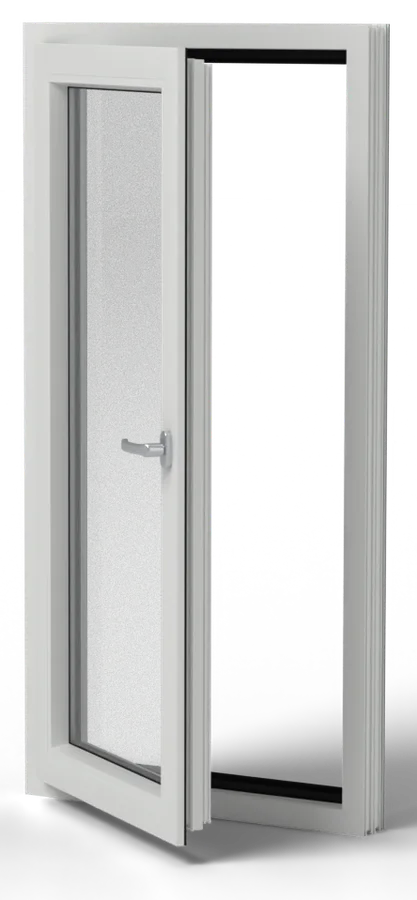
Vi6 casement, four tested glasses. Intertek report J4759.
Tap anything on the street to hear it. Headphones help.
Lab curve of a sealed window, less 5 dB for a real wall, never below the room's own 35 dB(A).
All twelve, window closed.
Levels in dB(A). Outside levels are typical, not measured at any building. Inside = the lab curve of a sealed window, less 5 dB for a real wall, and never below the room's own 35 dB(A).
| Noise | Outside | Inside | What is left |
|---|---|---|---|
| Elevated traina train passing on an elevated line beside the building | |||
| Bus or trucka bus or heavy truck pulling away below the window | |||
| Avenue trafficsteady traffic on a busy avenue | |||
| Ambulance sirenan ambulance passing with the siren on | |||
| Car horna car horn held down at the curb | |||
| Reversing beepera truck backing up with its beeper on | |||
| Jackhammera jackhammer on the sidewalk across the street | |||
| Airplane overheada jet on approach, under the flight path | |||
| Garbage trucka garbage truck compacting at 5 am | |||
| Schoolyarda schoolyard at recess | |||
| Birdsbirds in the tree outside | |||
| Heavy rainheavy rain on the street and the sill |
Glass stops pitch better than rumble.
Every window stops high sounds more easily than low ones. On all four of these glasses the tested loss is 12 to 16 dB greater in the range where a siren sings than in the range where a bus or a train rumbles. That is why the ambulance fades to a whisper before the garbage truck does.
The heavier glasses earn their rating in the low bands. Between the standard glass and the acoustic ones, the loss at 200 to 400 Hz grows by 14 to 20 dB. That is the band that decides whether a bedroom on an avenue sleeps.
Honest about what this is.
The reductions are the transmission-loss curves from the Intertek test of the Vi6 casement, applied band by band to each noise. The outside levels are typical figures from published noise references, chosen for a window a few stories up. The sounds you hear are synthesized stand-ins that sit in the right bands, until we record the real ones on a job site; playback is compressed so the quiet ones stay audible on a laptop.
A laboratory measures one sealed window in a heavy wall. A real room also takes sound through the wall, the vents and the floor, and has a hum of its own, so every inside number here carries a 5 dB allowance for the building and never drops below 35 dB(A), the quiet of an ordinary room. An open casement is, for sound, an open wall, so "window open" shows the outside level.
High Performance. Made for —
Have a noise requirement?
Send the acoustic report with your plans. We match the glass to it.